Conjunction (used in writing and formal speech only) (Intermediate ㊥ 3)
A conjunction which marks a cause that involves excessive action.
Equivalent: Because of too much ~; because ~ too much; so ~ that ~
| (i) Noun | のあまり | |
| 心配のあまり | Because of too much anxiety | |
| (ii) Vinformal | あまり | |
| 用心するあまり | Someone is so cautious that |
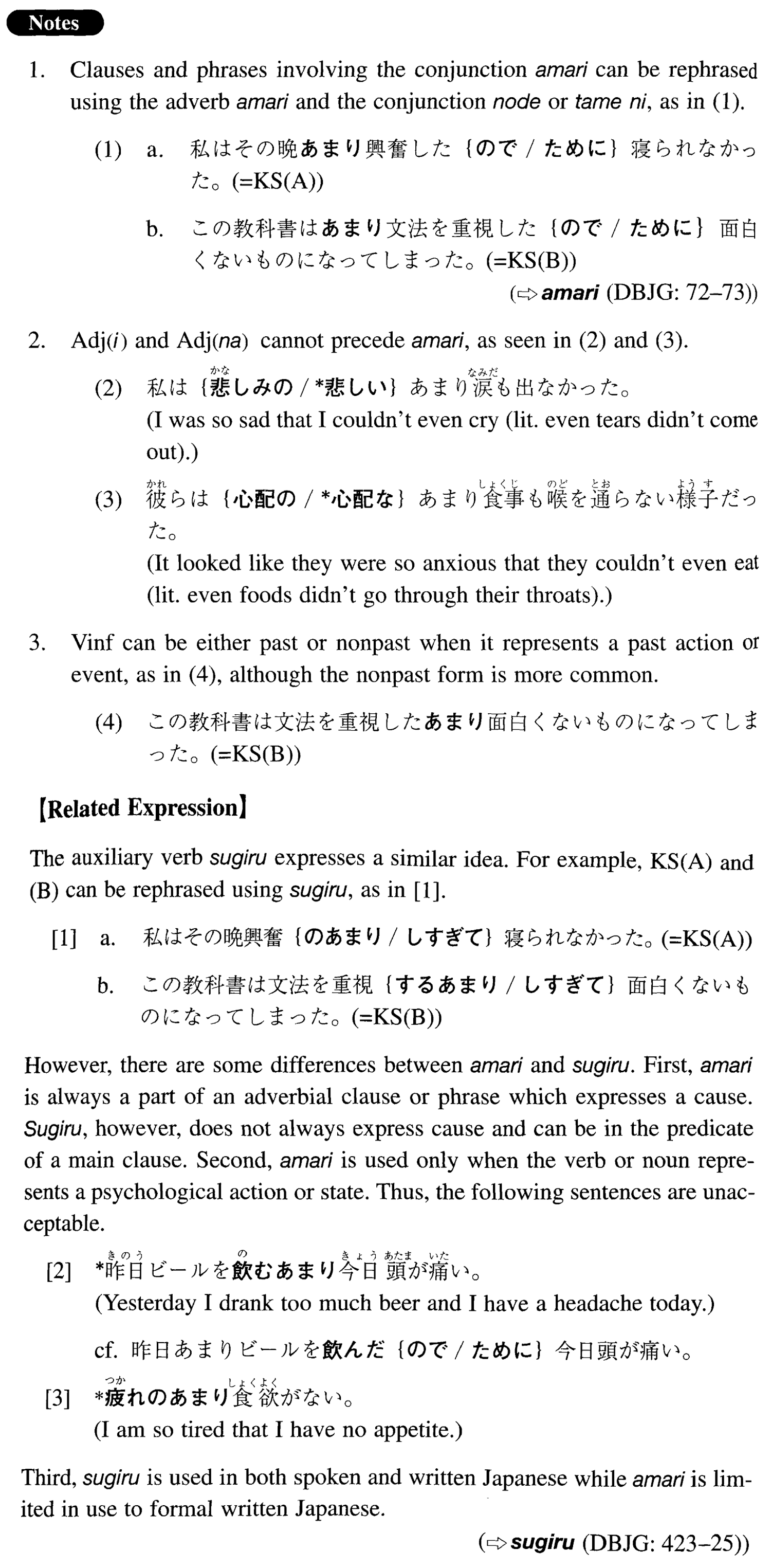
1. Clauses and phrases involving the conjunction あまり can be rephrased using the adverb あまり and the conjunction ので or ために, as in (1).
(⇨ あまり㊦)
2. Adjective い and Adjective な cannot precede あまり, as seen in (2) and (3).
3. Verb informal can be either past or nonoast when it represents a past action or event, as in (4), although the nonpast form is more common.
【Related Expression】
The auxiliary verb 過ぎる expresses a similar idea. For example, Key Sentence (A) and (B) can be rephrased using 過ぎる, as in[1].
[1]
However, there are some differences between あまり and 過ぎる. First, あまり is always a part of an adverbial clause or phrase which expresses a cause. 過ぎる, however, does not always express cause and can be in the predicate of a main clause. Second, あまり is used only when the verb or noun represents a psychological action or state. Thus, the following sentences are unacceptable.
[2]
[3]
Third, 過ぎる is used in both spoken and written Japanese while あまり is limited in use to formal written Japanese.
(⇨ 過ぎる㊦)